

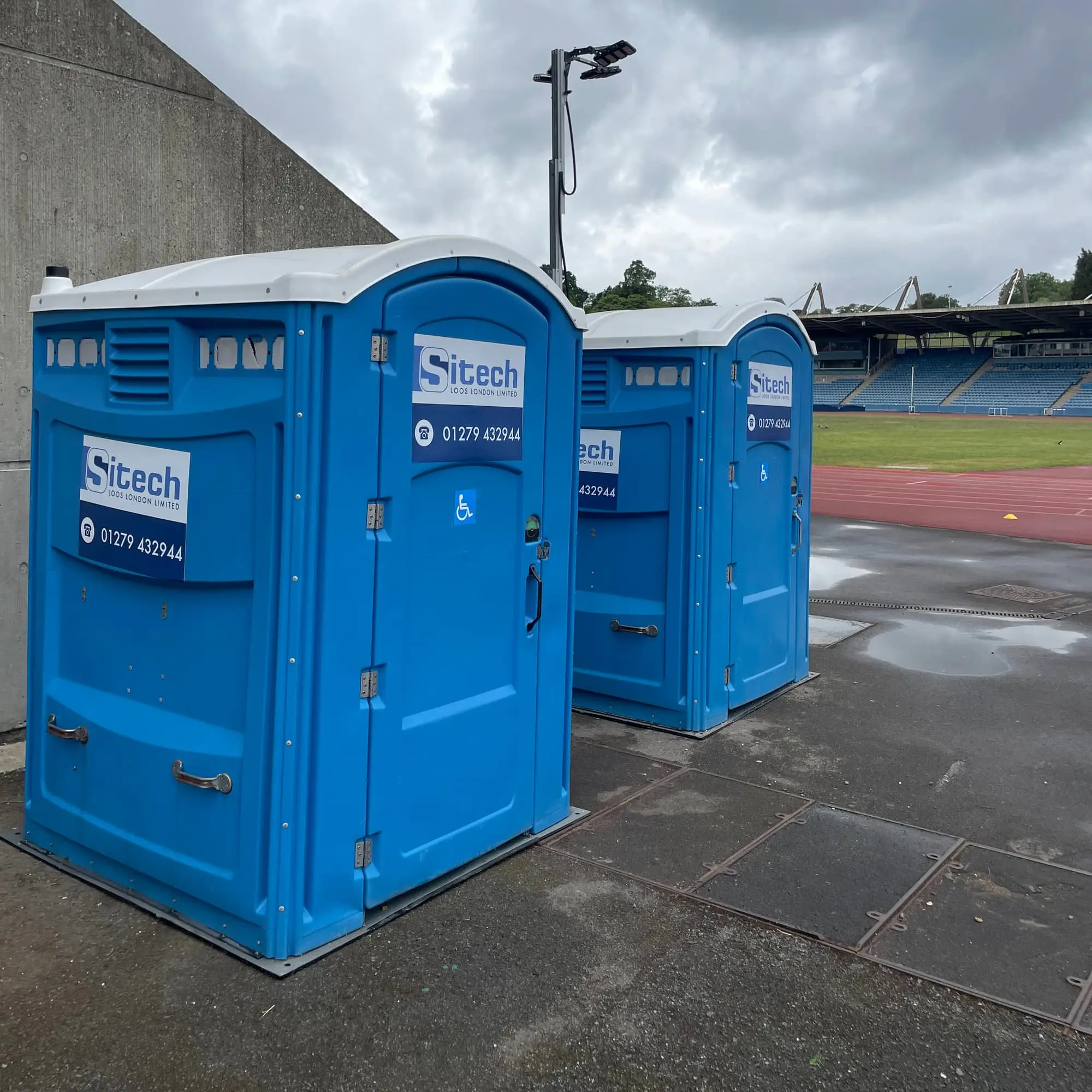
Disabled Portaloo Hire: Quick Answer
🎯 Quick Answer
A disabled access portable toilet costs £75–£120 per unit per week to hire, excluding VAT, with weekly servicing included. Delivery and collection are charged per job, typically £30–£40 each way. No UK law sets a fixed number of accessible toilets for events or construction sites. The Equality Act 2010 instead expects employers and organisers of public events to make reasonable adjustments, and the Purple Guide’s baseline for a typical local event is at least one.
- Weekly rate: £75–£120 per unit, servicing included
- Four-week hire, one unit: roughly £360–£560 all in, excluding VAT
- The law: reasonable adjustments under the Equality Act 2010, not a fixed ratio
- The unit: 1.57 m × 1.57 m footprint, 2.21 m high, room for a wheelchair user to turn inside
- Entry: low threshold, no ramp, so the approach must be firm and level
Read on for what the unit gives you, what the law really asks, and the placement mistakes that make an accessible toilet unusable.
Disabled portaloo hire is usually the most expensive line on a toilet quote, and the one people are least sure about. Do you legally need one? How many? And will a portable unit actually work for a wheelchair user?
At Sitech Loos London, we hire accessible units to construction sites and public events across London and the South East, including the BBC Antiques Roadshow. This guide sets out what they cost, what the law says, what the unit gives you, measured rather than marketed, and how to place it so it’s genuinely usable.
ℹ️ Transparency: Prices are indicative ranges from our own price list, not fixed quotes, and exclude VAT. Unit dimensions come from our own disabled access units. The legal sections are general guidance, not legal advice, and every legal point links to its source at the end.
Table of Contents
- How Much Does Disabled Portaloo Hire Cost?
- What Do You Actually Get? The Unit, Measured
- Is a Disabled Toilet a Legal Requirement?
- Does a Portable Unit Meet Building Regulations?
- How Many Accessible Toilets Do You Need?
- Where to Put It: Mistakes That Make It Unusable
- Frequently Asked Questions
- Conclusion
- References
How Much Does Disabled Portaloo Hire Cost?
Our disabled access unit costs £75–£120 per unit per week to hire, excluding VAT, with weekly servicing, consumables and licensed waste disposal included. That makes it the most expensive unit on our price list, at more than double the £32 starting rate for a standard chemical toilet.
The difference is the unit, not a surcharge for accessibility. It’s a bigger, heavier cabin than a standard toilet, so it takes up more room on the delivery vehicle and needs more careful siting when it arrives.
What does that look like over a real hire? Take one accessible unit for four weeks. The hire comes to £300–£480, and delivery plus collection adds roughly £60–£80, so the first month lands at about £360–£560 before VAT. London and tight-access sites sit towards the top of that range. Our portable toilet hire cost guide explains how transport charges work in more detail.
One-off event hires work differently. A weekend event is quoted per job rather than per week, because delivery and collection make up most of the cost on a short hire. The quote depends on how many units you need, how long they’re on site, whether they need servicing during the event, and access for delivery.
What Do You Actually Get? The Unit, Measured
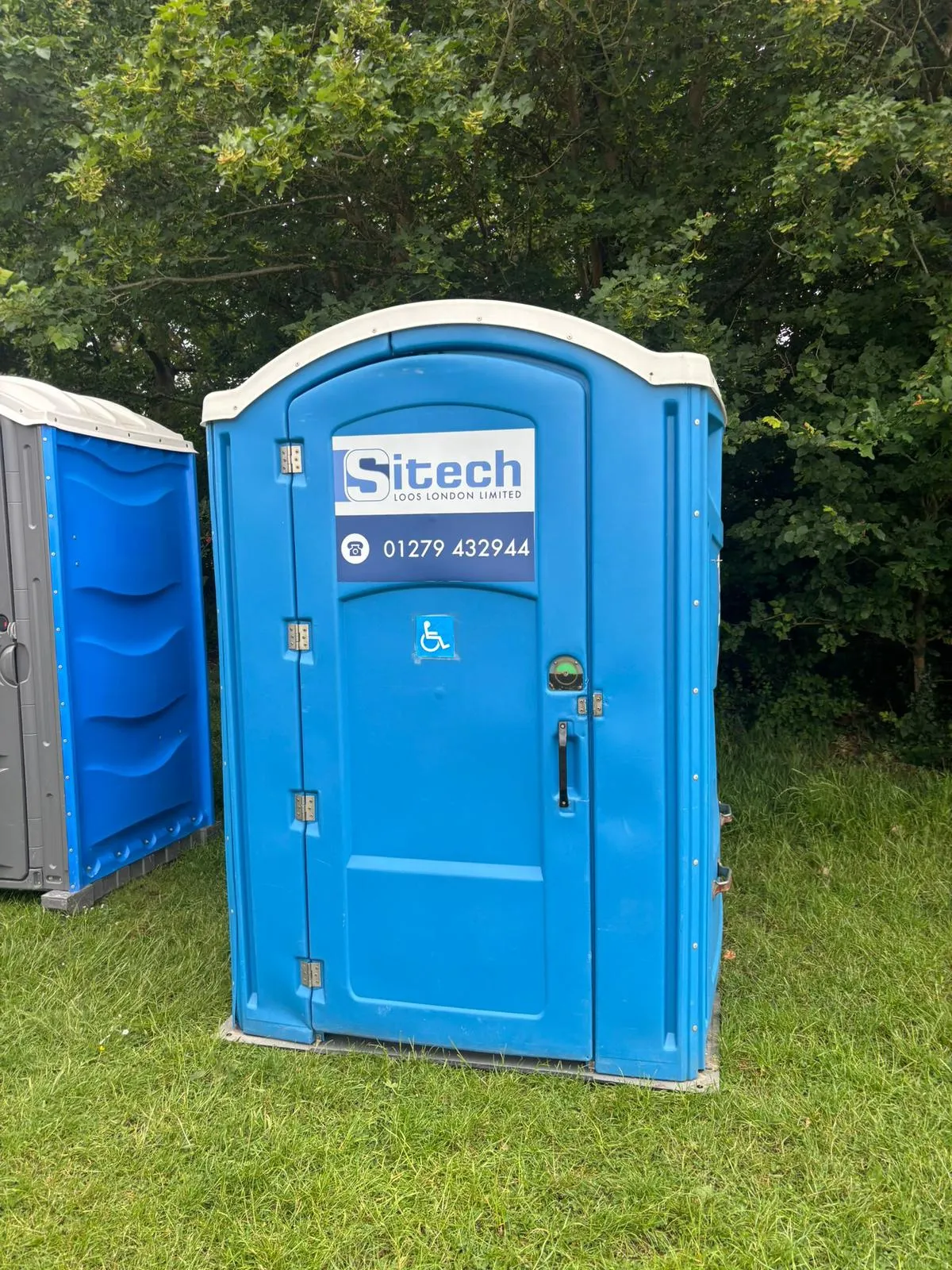
A disabled access unit is a larger, self-contained toilet cabin with a low-threshold entrance, grab rails and a wider door. These are the measurements of the units we hire out, so you can check the fit against your site before you book.
| Specification | Sitech disabled access unit |
|---|---|
| Height | 2.21 m |
| Width | 1.57 m |
| Depth | 1.57 m |
| Internal floor area | 1.87 m² |
| Waste tank | 132 litres |
| Entrance | Low threshold at ground level, no ramp |
| Inside | Grab rails, anti-slip floor, low-level hand sanitiser |
| Baby changing | Available on request |
Measurements for the disabled access units in the Sitech Loos London fleet. Width and depth are the unit’s overall footprint.
There’s room inside for a wheelchair user to turn around fully, which matters more than any single figure in the table. It means someone can enter forwards, transfer using the grab rails, and leave forwards, rather than reversing out through the door. If you use a larger powered wheelchair or a mobility scooter, call us to check the fit before you book.
Two numbers deserve attention at the planning stage. The first is the footprint. At 1.57 m square, the unit needs more standing space than a standard cabin, plus clear space in front of the door. The second is the 132-litre waste tank. On a building site with a few users, weekly servicing is plenty. At a busy public event, plan servicing around expected use rather than assuming once a week will do.
Is a Disabled Toilet a Legal Requirement?
Not as a fixed number. No UK law says you must hire a set number of accessible toilets. Instead, the Equality Act 2010 requires employers and anyone serving the public to make reasonable adjustments, so disabled people aren’t put at a substantial disadvantage. That’s a large group: in 2024/25, 16.7 million people in the UK, a quarter of the population, reported a disability (DWP, Family Resources Survey 2024/25).
The duty works differently depending on who you are.
- Organisers of public events, and venues, are service providers, and their duty is owed to disabled people generally (Equality Act 2010, Schedule 2). It’s anticipatory. The Equality and Human Rights Commission’s 2026 Code of Practice, in force since 5 August 2026, says providers should not wait until a disabled person wants to use a service. A private party or wedding host isn’t a service provider, but a venue you hire is.
- Employers owe the duty to disabled employees and job applicants (Schedule 8). There’s no duty where you don’t know about someone’s disability and couldn’t reasonably be expected to.
- Neither can charge for it. Section 20(7) of the Act stops you passing the cost of an adjustment on to the disabled person it’s for.
Construction sites: the regulation most people miss
The Construction (Design and Management) Regulations 2015 require “suitable and sufficient sanitary conveniences” at readily accessible places, but they say nothing about disabled workers (CDM 2015, Schedule 2).
The rule that does is regulation 25A of the Workplace (Health, Safety and Welfare) Regulations 1992. Most of those regulations don’t apply to construction sites, but regulation 3 keeps 25A in force there. It requires that, where necessary, lavatories used by disabled workers are “organised to take account of such persons” (legislation.gov.uk). Our guide to construction welfare regulations covers the wider welfare duties.
What about “DDA compliant”?
It’s an out-of-date label, though you’ll still see it on hire websites and quotes. The Disability Discrimination Act 1995 was largely repealed in England, Scotland and Wales by the Equality Act 2010, from 1 October 2010. The Equality Act largely doesn’t extend to Northern Ireland, where the DDA still applies. There’s no DDA specification for a portable toilet, so the phrase describes good intent, not a standard you can check.
The same goes for units sold as “fully compliant with the Equality Act”. The Act places duties on people, not certification on products. A well-chosen unit helps you meet the duty. It can’t meet it for you.
Does a Portable Unit Meet Building Regulations?
No, and it isn’t meant to. In England, Approved Document M’s guidance shows a minimum wheelchair-accessible toilet of 2.2 m deep by 1.5 m wide, including a 1.5 m × 1.5 m wheelchair turning space (HM Government, Approved Document M, Volume 2, Diagram 18). Our unit’s entire external footprint is 1.57 m × 1.57 m.
Part M is written for buildings. The Building Regulations also exempt temporary buildings that stay in place for 28 days or less, and buildings on a construction site used only during the works (Building Regulations 2010, Schedule 2).
So what is a portable accessible unit for? It’s a temporary reasonable adjustment. It gives a low-threshold entrance, grab rails, a wider door and room to turn, on a site or event where there’s no building WC at all. It won’t match a purpose-built accessible toilet in every dimension, and it shouldn’t be sold as if it does. Even in a permanent building, Approved Document M itself notes that meeting Part M doesn’t necessarily mean meeting Equality Act duties.
BS 8300-2 is different. It’s a British Standard code of practice rather than law, written mainly for buildings, but its scope does include temporary structures the public use (BSI). If a client specification or venue asks for “Part M” or “BS 8300” compliant toilets, ask which provisions they need. Then talk to us, and we’ll tell you honestly whether our unit fits the brief.
It also isn’t a Changing Places toilet. Those are much larger rooms, at least 12 m², with a height-adjustable adult changing bench and a ceiling hoist, for people who may need up to two assistants (Changing Places Consortium). They’ve been required in certain large new buildings in England since 1 January 2021, such as entertainment venues for 350 or more people. Mobile Changing Places units exist as a separate, specialist hire.
How Many Accessible Toilets Do You Need?
The Purple Guide, the events industry’s safety guidance, says a typical local event should provide at least one dedicated accessible toilet (Events Industry Forum). For a typical local event, that sits alongside one female toilet per 100 attendees, and one male toilet per 500 plus a urinal per 150. Longer events, and those serving alcohol, need more. Beyond that minimum, the number of accessible units is a judgement based on your audience.
You’ll find more precise ratios online, such as one accessible toilet per 75 disabled attendees. We couldn’t trace any of them to the Purple Guide’s public text or to UK legislation, so treat them as rules of thumb rather than requirements. Our own working rule is simpler: put an accessible unit in every toilet block the public uses, so no one has to cross the site to find one.
Audience matters more than headcount. A family day, a heritage show or an event aimed at older visitors will see heavier demand for accessible toilets than a young, short-stay crowd. Our outdoor event sanitation guide covers overall toilet numbers for London events.
Construction sites are simpler. Provide accessible welfare as soon as a disabled worker is on the team, and site it near where they work, not at the far end of the compound. If you know in advance, book it with the rest of your welfare so it arrives on day one.
Where to Put It: Mistakes That Make It Unusable
Put it on firm, level, step-free ground, at the end of the main toilet block nearest the access route, with clear space in front of the door. Get that wrong and the toilet isn’t accessible, whatever the sign says. It’s a common failure: in Euan’s Guide’s 2024 Access Survey, 73% of respondents had come across an accessible toilet they couldn’t use (Euan’s Guide).
Because our units have a low threshold rather than a ramp, the ground and the route matter even more. Before delivery day, check these:
- Firm, level standing. Tarmac, paving, trackway or dry, compacted ground. Avoid loose gravel, ruts and slopes, which make the threshold hard to cross.
- A step-free route. No kerbs, steps or unprotected cable runs between the unit and car parks, viewing areas or the work area.
- Space at the door. Leave clear space in front so a wheelchair user can line up with the door. Don’t back it onto fencing, generators or queue barriers.
- With the main block, not hidden away. Put it at the end of the toilet block nearest the access route, so disabled visitors aren’t sent somewhere separate. Then stop the general queue from swallowing it.
- Lighting and signage. For evening events, light the route and the unit. Sign it clearly from the main walkways.
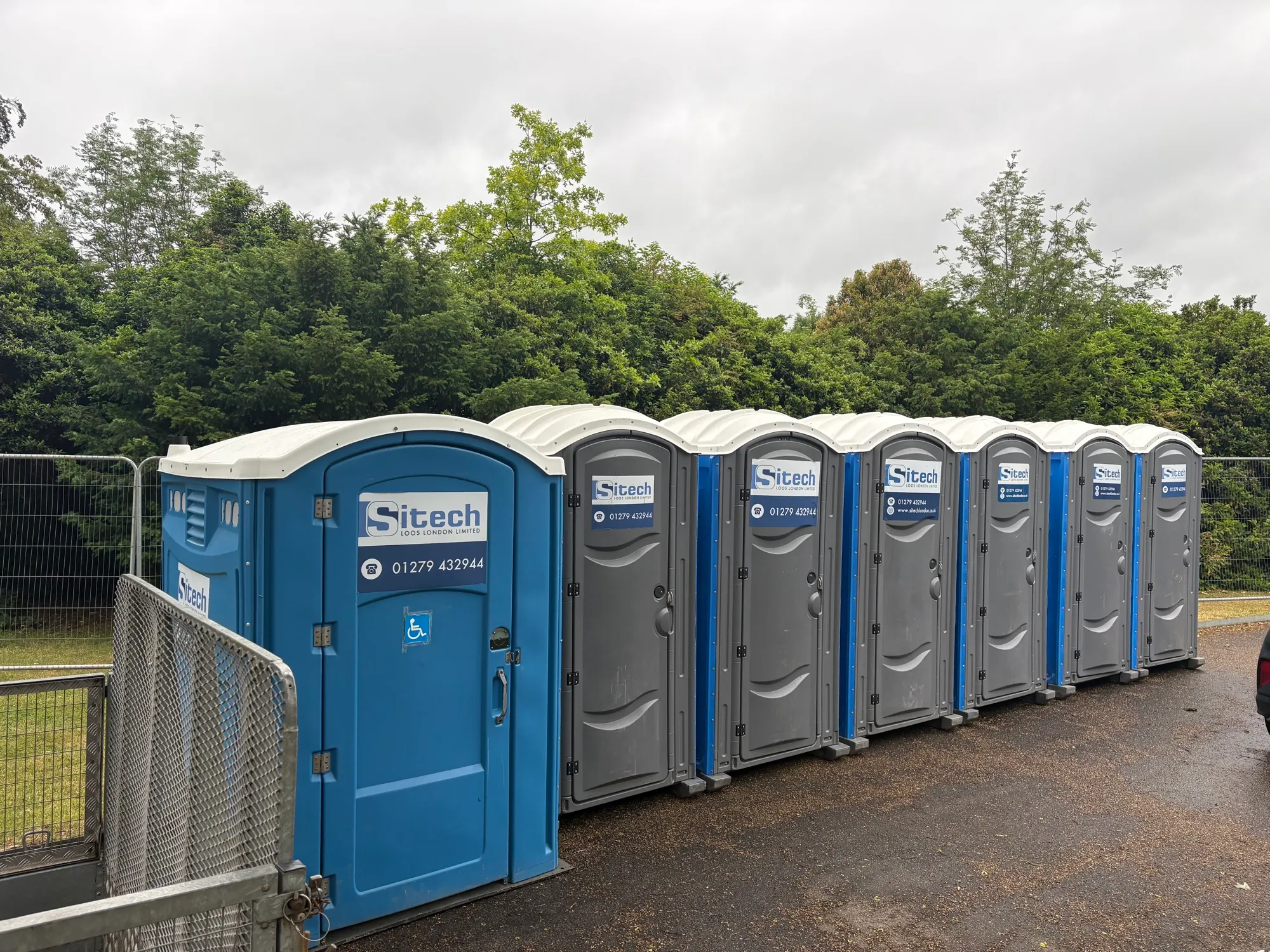
When we supplied the BBC Antiques Roadshow, the accessible unit went at the end of a row of six event toilets, on firm tarmac. It’s the layout we’d recommend for most public events. The photo also shows the one thing to watch: while vehicles come and go, check nothing is left in front of the accessible door.
Frequently Asked Questions
How much does disabled portaloo hire cost?
Our disabled access units cost £75–£120 per unit per week, excluding VAT, with weekly servicing, consumables and licensed waste disposal included. Delivery and collection are charged per job, typically £30–£40 each way. A single unit on a four-week hire usually lands at about £360–£560 before VAT. One-off event hires are quoted per job.
Is it a legal requirement to provide a disabled toilet at an event?
No law sets a fixed number, but the Equality Act 2010 requires organisers of public events to make reasonable adjustments for disabled people, and to plan for them in advance. The Purple Guide, the events industry’s safety guidance, says a typical local event should provide at least one dedicated accessible toilet.
Are portable disabled toilets DDA compliant?
The label is out of date. The Disability Discrimination Act 1995 was largely repealed in England, Scotland and Wales by the Equality Act 2010, from 1 October 2010. It still applies in Northern Ireland. There’s no DDA specification for a portable toilet, so “DDA compliant” on a GB quote describes intent, not a standard.
Do disabled portaloos have ramps?
Ours don’t. Our disabled access units have a low threshold at ground level rather than a ramp. That means the ground and the approach route matter more than the unit itself: it needs firm, level, step-free standing, such as tarmac, paving or trackway, with no kerbs or ruts on the way in.
Can you hire a disabled portaloo with baby changing?
Yes. A baby changing table is available on request for our disabled access units. Ask for it when you book so the unit we send has one. It’s worth considering for family events, fêtes and public parks, where parents otherwise have nowhere suitable to change a baby.
Conclusion
Disabled portaloo hire costs £75–£120 per unit per week, with servicing included, and around £360–£560 for a typical four-week hire once transport is added. The law doesn’t hand you a number. It asks employers and organisers of public events to make reasonable adjustments, and for public events it expects you to plan ahead.
The unit is only half of it. A portable accessible toilet is a temporary adjustment, not a building-regulations WC, and it’s only usable if the ground and route to it are firm, level and step-free. Get the siting right and a single well-placed unit does its job.
Planning an event or a site with disabled users? Sitech Loos London supplies fully serviced disabled access units across London and the South East. Get an instant quote or call us on 01279 432 944, and we’ll help you work out how many you need and where they should go.
References
- Legislation.gov.uk. (2010). Equality Act 2010, section 20: Duty to make adjustments. Retrieved 10 September 2026.
- Legislation.gov.uk. (2010). Equality Act 2010, Schedule 2: Services and public functions, reasonable adjustments. Retrieved 10 September 2026.
- Legislation.gov.uk. (2010). Equality Act 2010, Schedule 8: Work, reasonable adjustments. Retrieved 10 September 2026.
- Equality and Human Rights Commission. (2026). Code of Practice: Services, public functions and associations, paras 7.20–7.25. Retrieved 10 September 2026.
- Legislation.gov.uk. (2010). The Equality Act 2010 (Commencement No. 4) Order 2010, article 2. Retrieved 10 September 2026.
- Legislation.gov.uk. (2015). The Construction (Design and Management) Regulations 2015, Schedule 2. Retrieved 10 September 2026.
- Legislation.gov.uk. (1992). The Workplace (Health, Safety and Welfare) Regulations 1992, regulation 25A. Retrieved 10 September 2026.
- HM Government. Approved Document M, Volume 2: Buildings other than dwellings (2015 edition incorporating 2020 and 2024 amendments), Diagram 18 and para 5.10. Retrieved 10 September 2026.
- Legislation.gov.uk. (2010). The Building Regulations 2010, Schedule 2: Exempt buildings and work. Retrieved 10 September 2026.
- British Standards Institution. BS 8300-2:2018 Design of an accessible and inclusive built environment. Buildings. Code of practice. Retrieved 10 September 2026.
- Events Industry Forum. The Purple Guide: Sanitation. Retrieved 10 September 2026.
- Changing Places Consortium. Changing Places toilets. Retrieved 10 September 2026.
- Department for Work and Pensions. (2026). Family Resources Survey: financial year 2024 to 2025. Retrieved 10 September 2026.
- Euan’s Guide. Access Survey 2024 results. Retrieved 10 September 2026.
